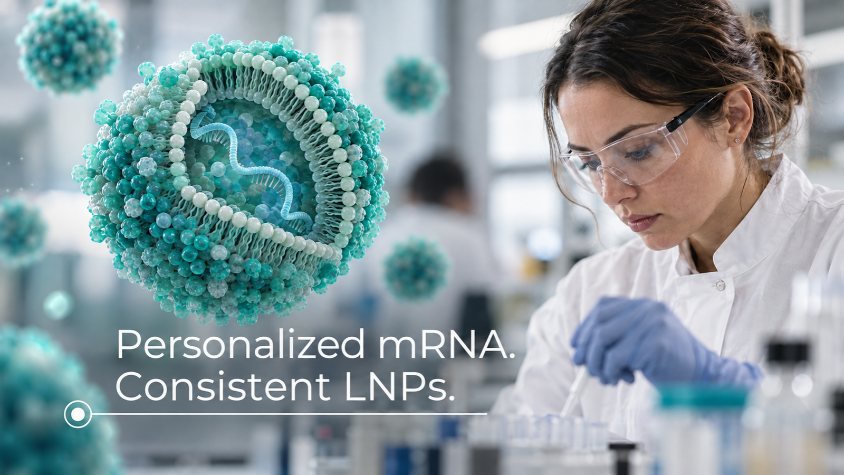
The role of LNPs in Moderna's personalized mRNA cancer vaccine

ATEM Structural Discovery
4 min read

The role of LNPs in Moderna’s personalized mRNA cancer vaccine

Summary

Intismeran is a cancer vaccine designed around mutations in an individual patient’s tumor. After a Phase 3 melanoma trial reported improvements in recurrence-free survival in August 2026, a less visible challenge emerges: each patient’s mRNA is different, but the lipid nanoparticles (LNPs) delivering it must be made consistently. How can developers tell whether the particles remain consistent from one patient to the next?

Moderna’s personalized mRNA cancer vaccine Phase 3 win

In melanoma patients, surgery is often used to remove the melanoma, but people with high-risk disease can still experience a recurrence if cancer cells remain undetected. Keytruda, an immunotherapy medication, helps the immune system attack cancer by blocking a receptor that can limit T-cell activity. In the Phase 2b KEYNOTE-942 trial, researchers evaluated whether adding a cancer vaccine, intismeran, to Keytruda could improve outcomes for patients with high-risk melanoma following surgery. At five years, the estimated recurrence-free survival rate was 68.8% among patients who received the combination, compared with 49.1% among those who received Keytruda alone [1].

The intismeran vaccine was designed to give T cells more specific targets. Tumors accumulate mutations, some of which produce altered protein fragments called neoantigens. These can help the immune system distinguish cancer cells from healthy tissue. Because tumors carry different mutations, the vaccine is tailored to each patient. Tumor DNA is sequenced alongside DNA from healthy tissue to identify tumor-specific mutations, and up to 34 selected neoantigens are encoded in a single mRNA [2]. Once the mRNA reaches cells, they produce the target fragments, which T cells can then recognize. Keytruda is given alongside the vaccine to help sustain the immune response.

Moderna and Merck began developing the approach in 2016. On 19 August 2026 the companies announced that the Phase 3 INTerpath-001 trial, in 1,137 patients, had shown improvements in both recurrence-free and distant-metastasis-free survival over Keytruda alone, though no figures were released yet [3].

How are LNPs involved in this vaccine?

Therapeutic mRNA is vulnerable to degradation and does not readily cross cell membranes. So, the mRNA is packaged in an LNP that helps deliver it into cells [4]. Particle structure can influence how effectively mRNA reaches cells [5], and in an individualized vaccine the mRNA payload changes from patient to patient.

Characterization must also fit within a tight manufacturing timeline. A recent review describes a target of six weeks or less from tumor sequencing to vaccine production [6]. Characterization methods therefore need to provide meaningful data quickly enough to support development and comparability assessments.

The challenges of LNP characterization 

Dynamic light scattering (DLS) is widely used to characterize particle size, but it does not directly resolve individual particle morphology [7]. Two samples with similar average sizes can still differ in the internal structure of the particles.

Intismeran is the first individualized neoantigen vaccine to reach a Phase 3 result, and more are in late-stage trials. As more personalized mRNA therapies advance through development, establishing consistency across individualized products becomes increasingly important.

Where cryo-EM fits 

Cryo-electron microscopy (cryo-EM) allows researchers to examine individual particles and quantify size and morphology across a population [7]. ATEM’s AI-powered analysis measures thousands of particles per sample. In its validation study, the 99% confidence interval for mean diameter narrowed to 0.92nm when 5,000 particles were analyzed, though a precise mean does not by itself establish comparability between formulations [8]. Alongside size, the analysis characterizes the morphology of individual particles, giving a fuller picture of what a sample contains.

During development, researchers could formulate representative batches under the same conditions and compare the particle distributions each one produces, with replicates to show how much of any difference is ordinary variation. With a reported turnaround of one to two weeks per sample set, this approach can support development-stage characterization [9].

If you are developing an mRNA-LNP product and need particle-level data during formulation work, check ATEM’s Lipid Nanoparticle Characterization service.

Contact us to discuss how we can support your program