Resources & Insights
Blog
Why apply cryo-EM epitope mapping to antibody discovery campaigns against challenging membrane proteins?
For a recent study, Salipro Biotech, Bio-Rad Laboratories, and ATEM Structural Discovery collaborated to establish an integrated workflow for antibody discovery and structural characterization of the challenging membrane protein target CXCR4. Salipro generated and stabilized the solubilized CXCR4 antigen in a native-like lipid environment, providing a high-quality target for antibody discovery. Using this antigen, Bio-Rad’s Pioneer™ antibody discovery platform generated high-affinity antibody fragments (Fabs). ATEM then applied its cryo-EM expertise to characterize the resulting CXCR4–Fab complexes and perform 3D epitope mapping using materials provided by the two partner organizations. Together, the three complementary capabilities created a seamless workflow spanning antigen preparation, antibody discovery, and high-resolution structural characterization—enabling precise definition of antibody binding sites and supporting the rational optimization of therapeutic leads.
To understand how this collaboration addressed the challenges of antibody discovery against a complex GPCR target, we explore the project through a series of key questions.
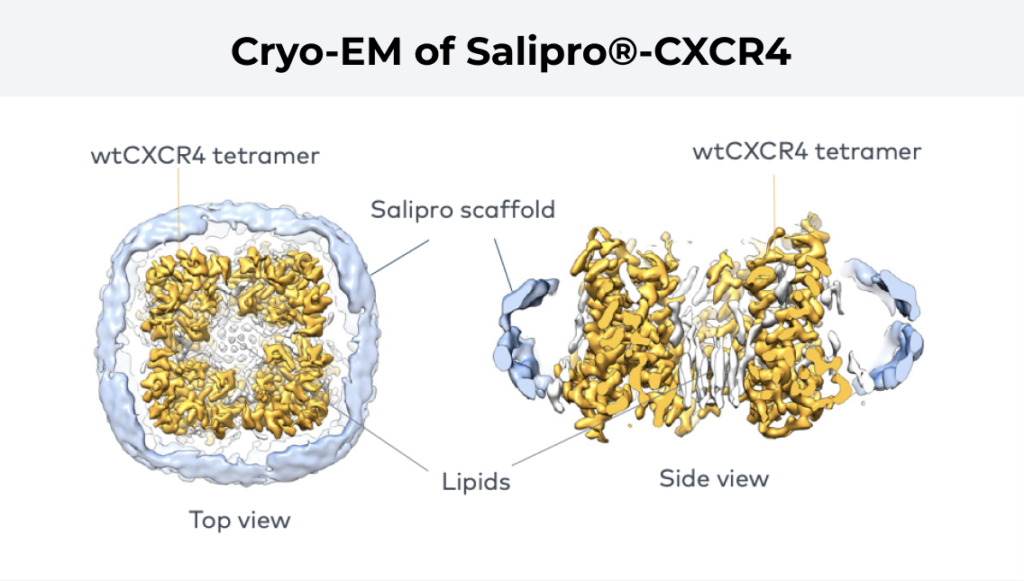
GPCRs like CXCR4 are inherently unstable once removed from the lipid bilayer. Traditional extraction using harsh detergents typically causes denaturation or aggregation, destroying the functional epitopes needed to generate high-affinity antibodies. The Salipro® platform encapsulates CXCR4 within a native-like lipid environment using the DirectMX® one-step methodology directly from crude cells, preserving both structural and functional integrity. This was confirmed by SEC (homogeneity, stability for 24+ hours at 4°C and RT), SPR and mass photometry (binding to natural ligand CXCL12 and antagonist AMD3100), and ultimately cryo-EM, which resolved a 2.8 Å structure of the wildtype receptor in its native tetrameric organization.
The phage display campaign against Salipro®-CXCR4 nanoparticles identified 48 unique Fabs, of which 33% demonstrated sub-nanomolar affinity without the need for further affinity maturation. These antibodies showed specific binding to Jurkat cells expressing endogenous CXCR4, blocked CXCL12-mediated Gαi activation in a cAMP assay, and inhibited Jurkat cell migration in a Transwell assay at efficacy matching the clinical benchmark ulocuplumab.
After identifying functional lead antibodies, 3D epitope mapping was added to precisely define how each antibody interacts with CXCR4 at a structural level. This is particularly valuable for GPCR targets because cryo-EM bypasses the need for crystallization and preserves the receptor in a native-like environment.
ATEM’s workflow first screened Salipro®-CXCR4–Fab complexes for stability and suitability via a pilot cryo-EM study. Initial 2D datasets were progressed to 3D reconstructions, where intermediate structures at 4–10 Å resolution were used to localize binding sites. Selected complexes were then advanced to high resolution (<4 Å), resolving detailed paratope–epitope interactions and side-chain orientations at near-atomic level. This allowed differentiation of candidates based on where and how precisely they engage the receptor, enabling rational lead selection.
By precisely defining the unique binding epitopes of each antibody on CXCR4 at near-atomic resolution, cryo-EM epitope mapping provided the structural evidence needed to support the generation of novel intellectual property. Knowing the exact paratope–epitope interactions distinguished each antibody’s binding mode from existing known binders, offering a clear structural basis for IP claims around differentiated therapeutic leads.
Membrane protein antibody discovery often depends on preserving native-like target structure, then understanding how functional candidates engage that target at the epitope level. As this Salipro Biotech case shows, combining native-like antigen presentation with cryo-EM 3D epitope mapping can help teams move beyond binding and activity data to structurally grounded lead differentiation, mechanism-of-action insight, and stronger IP positioning.
For teams working on challenging membrane protein targets, ATEM’s cryo-EM epitope mapping workflow is designed to deliver decision-ready structural insight from antibody–antigen complexes, including complex GPCR targets.
You are currently viewing a placeholder content from Vimeo. To access the actual content, click the button below. Please note that doing so will share data with third-party providers.
More InformationYou are currently viewing a placeholder content from YouTube. To access the actual content, click the button below. Please note that doing so will share data with third-party providers.
More InformationYou need to load content from reCAPTCHA to submit the form. Please note that doing so will share data with third-party providers.
More Information