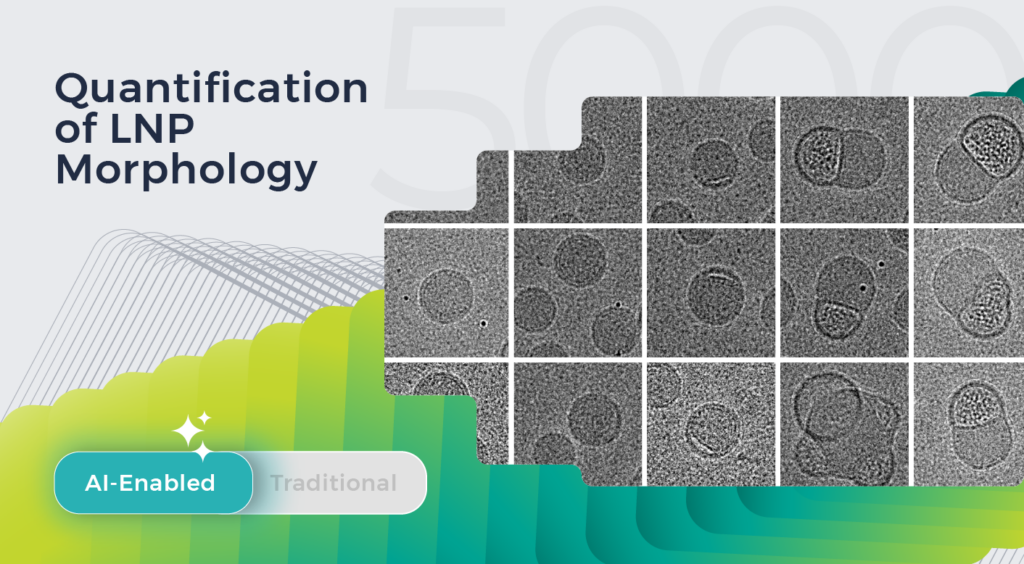
Quantification of LNP morphology: traditional qualitative vs. AI enabled quantitative workflows

ATEM Structural Discovery
4 min read

Quantification of LNP morphology: traditional qualitative vs. AI enabled quantitative workflows

Summary

Lipid nanoparticle (LNP) morphology directly influences potency and stability, yet it is still often treated as a qualitative observation rather than a measurable, quantifiable parameter. Cryo-electron microscopy (cryo-EM) provides this quantification capability. While the imaging itself is well established, analyzing the micrographs remains a major bottleneck in traditional, manual workflows. This article explores how AI-based platforms overcome this challenge by automatically annotating thousands of particles in seconds rather than months.

Why qualitative LNP analysis is not enough

Lipid nanoparticles (LNPs) are drug delivery vehicles, and their “structure-to-function” relationship means that how the particles are built – their size, shape, and internal structure – directly affects how well they deliver their payload. For example, Bleb formation (i.e. bleb-like membrane enclosed structures) in mRNA-LNPs correlates with improved transfection potency [1], and internal phase morphology predicts stability [2]. Particle size in turn, has been shown to influence both payload delivery efficiency [3] and vaccine immunogenicity [4], and internal phase morphology predicts stability [3]. The FDA’s nanomaterial guidance accordingly recommends characterizing morphology, size distribution, shape, and aspect ratio as critical quality attributes [5]. Despite the clear impact of LNP morphology, it is still often assessed qualitatively, sometimes even subjectively, rather than measured quantitatively.

Hence, the limitation of traditional workflows is therefore not the imaging itself, but the manual analysis that follows. AI-powered platforms remove this bottleneck by automating particle annotation across entire datasets.

Moving towards quantitative LNP analysis with AI-powered Cryo-EM

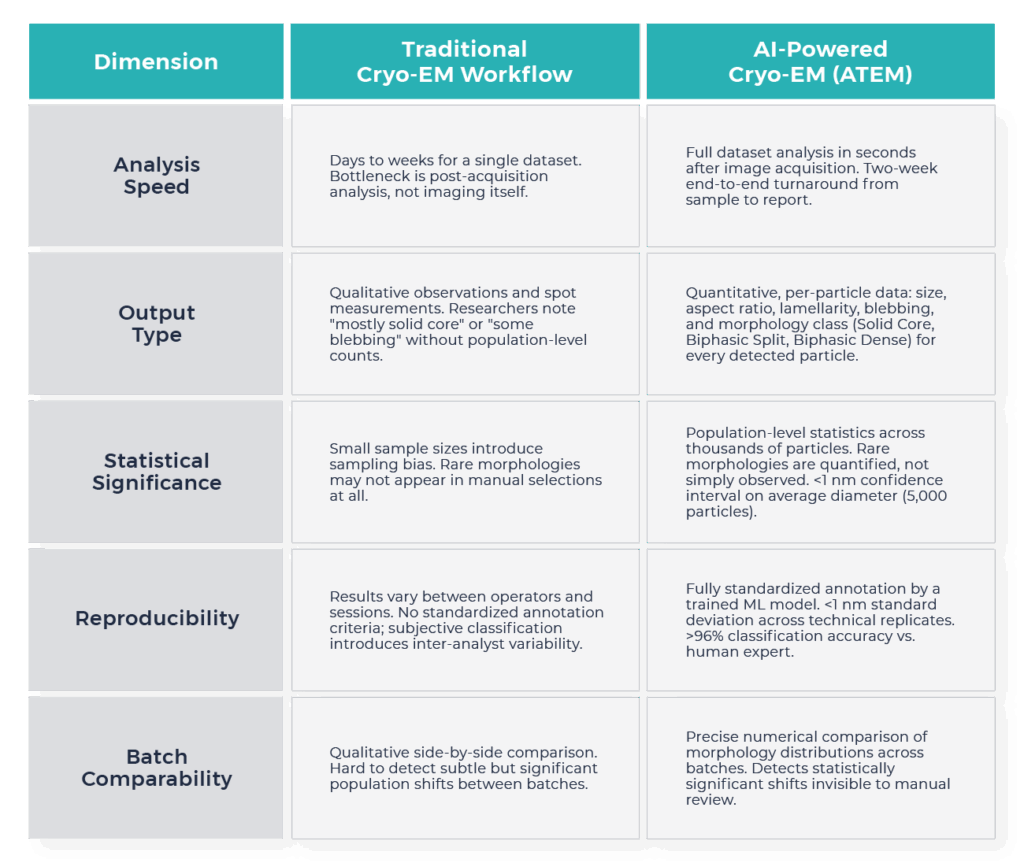
Obtaining quantitative LNP data requires a technique that can directly visualize individual nanoparticles. Cryo-electron microscopy (cryo-EM) provides exactly that capability, imaging LNPs in a vitrified, near-native state that preserves their true structure [6]. While the imaging itself is well established, analyzing the micrographs remains a major bottleneck in traditional workflows: researchers manually inspect the micrographs and measure particle properties (such as size and morphology) one particle at a time [7]. Because this process is slow, manual or even semi-automatic picking of 100,000 particle images would require several man-months [8]. Hence, the limitation of traditional workflows is therefore not the imaging itself, but the manual analysis that follows. AI-powered platforms remove this bottleneck by automating particle annotation across entire datasets. Vitrification and imaging remain unchanged; the transformation lies in annotation: ATEM’s cryo-EM platform segments every detectable LNP across a full dataset, classifying each into Solid Core, Biphasic Split or Biphasic Dense, while simultaneously extracting per-particle size, aspect ratio, lamellarity and blebbing. This way, thousands of nanoparticles are annotated in seconds rather than months.

In consequence, the impact is not just speed, but scale. By analyzing thousands of particles per dataset, researchers turn cryo-EM images into statistically meaningful and precisely reproducible measurements of LNP morphology. Analyzing the full dataset ensures that even low-frequency morphology classes are captured, rather than lost in a small manual subset. In practice, this means researchers can directly quantify how particle population changes, including how specific morphologies convert into others [9].

Table I – Traditional vs AI-powered Cryo-EM workflows.

Is AI data reliable?

At ATEM, we compared the performance (i.e. accuracy) of our AI-powered platform versus expert human annotation, and we found that our platform yields a mean classification accuracy of 96.3% across morphology classes (95–98% per class), matching or exceeding inter-operator agreement in manual workflows. Evaluating the precision of the method across ten technical replicates and three operators, summarized measurements of mean particle diameter for 5.000 analyzed particles showed a coefficient of variation (CV) below 1% between the summarized results of each replicate, with a 99% Confidence Interval (CI) of ±0.6 nm [8], highlighting the leading results quality of the ATEM AI platform.

Access available demo reports and quantification tools below to experience the analytical depth provided by the statistically significant analysis.

How ATEM supports LNP research

ATEM works with biotech and pharmaceutical partners through GMP and non-GMP cryo- and electro-microscopy workflows, collaborating closely with scientific teams throughout research, preclinical, and clinical development.

If your next LNP project is already defined and you are looking for a data analysis partner, you can talk directly with our scientists. 

References

[1] Cheng, M.H.Y. et al (2023). Induction of Bleb Structures in Lipid Nanoparticle Formulations of mRNA Leads to Improved Transfection Potency. Advanced Materials, 35(31): 2303370. doi:10.1002/adma.202303370.

[2] Eygeris, Y. et al. (2020). Deconvoluting Lipid Nanoparticle Structure for Messenger RNA Delivery. Nano Letters, 20(6): 4543–4549. doi:10.1021/acs.nanolett.0c01386

[3] Chen, S., et al. (2016). Influence of particle size on the in vivo potency of lipid nanoparticle formulations of siRNA. Journal of Controlled Release, 235: 236-244. doi:doi.org/10.1016/j.jconrel.2016.05.059

[4] Hassett, K.J. et al. (2021). Impact of lipid nanoparticle size on mRNA vaccine immunogenicity. Journal of Controlled Release, 335: 237–246. doi:10.1016/j.jconrel.2021.05.021

[5] FDA (2022). Drug Products, Including Biological Products, That Contain Nanomaterials: Guidance for Industry. U.S. Food and Drug Administration. Available at: https://www.fda.gov/regulatory-information/search-fda-guidance-documents/drug-products-including-biological-products-contain-nanomaterials-guidance-industry

[6] Lučić, V. (2022). Computational methods for ultrastructural analysis of synaptic complexes. Current Opinion in Neurobiology, 76: 102611. doi:10.1016/j.conb.2022.102611

[7] Schindelin, J. et al. (2012). Fiji: an open-source platform for biological-image analysis. Nature Methods, 9(7): 676–682. doi:10.1038/nmeth.2019

[8] Wong, H.C. et al. (2004). Model-based particle picking for cryo-electron microscopy. Journal of Structural Biology, 145(1–2): 157-167. doi:10.1016/j.jsb.2003.05.001

[9] ATEM (2024). Quantifying Cryo-EM LNP Analysis: Method Validation & Case Study Data. Available at: https://atem.bio/services/lnp-characterization/#download